
The CRCF has become one of the most anticipated regulatory developments in the carbon removal market in recent years. Project developers, standard bodies and credit buyers have kept a close eye on its development, keen to understand how it will affect the market. The general feeling is that centralised adoption of EU-backed carbon removal methodologies would be good for the market, increasing legitimacy and standardisation in a market that has been criticised for fragmentation and inconsistency between projects and standards. But what actually is the CRCF, and what changes now that it is operational?
What is the CRCF?
The Carbon Removals and Carbon Farming Regulation (CRCF), formally known as EU Regulation 2024/3012, is the first EU-wide voluntary framework for certifying carbon removals and carbon storage. It covers three main activity types:
- Carbon farming: activities involving soil and biomass sequestration, lasting at least five years.
- Permanent carbon removals: removal and storage of CO2 for several centuries.
- Carbon storage in long-lasting products: such as timber-based construction materials, where carbon is stored for at least 35 years.
Voluntary standards like Puro.earth, Verra, Carbon Standards International and Isometric have been certifying carbon removals for years. The difference between these incumbent standards and the CRCF, is that the CRCF is underpinned by EU law. It has been developed and proposed by the European Commission, which gives it an extra layer of legitimacy compared to private standards, and also means its quality criteria are enforceable under EU law in a way that a private standard's rules are not. The CRCF also creates a pathway toward compliance use: the European Commission is mandated to present a proposal on integration with the EU Emissions Trading System by July 2026.
Existing standards can apply for recognition as CRCF certification schemes. Once accepted, they will operate parallel programmes: Puro.earth, for example, will run its existing Puro Standard (issuing CORCs) alongside a dedicated CRCF Program issuing CRCF Certified Units through the same platform. The two credit types are distinct, and the same removal tonne cannot generate both; the CRCF's own FAQ confirms that registering a removal benefit under any alternative framework alongside CRCF units would constitute double counting. Project developers will likely need to choose a certification pathway for each credit vintage.
What does the CRCF mean for integrity?
At a market level, the operationalisation of the CRCF has the potential to strengthen integrity by reducing fragmentation and driving greater standardisation across the market. All projects must meet four quality criteria:
- Quantification
- Additionality
- Long-term storage
- Sustainability
Together these make up the QuALITY criteria, and give buyers and regulators a standardised baseline against which all CRCF-certified projects can be assessed.
The European Commission has confirmed that certification schemes can apply requirements that go beyond CRCF minimum standards. Isometric, one of the first schemes to submit a recognition application, has built additional scientific safeguards on top of the CRCF baseline specifically for this reason. This means there can be variation in quality between certified units issued by different certification schemes, but the QuALITY framework ensures a minimum level of integrity for all credits.
At a project level, there have been contrasting views on the methodologies presented so far. The first methodologies, including biochar carbon removal, direct air capture with carbon storage and biogenic emissions capture with carbon storage, have been found to broadly align with existing VCM standards. According to ClimeFi, some adjustments would be required for existing projects seeking CRCF compliance. However, the carbon farming methodologies, which have not yet been formally adopted, have attracted more scrutiny. Carbon Market Watch and Öko-Institut have argued they fall short of the standards set by Article 6.4 of the Paris Agreement, with key concerns around baseline setting, leakage accounting and non-permanence risk. The drafts have been revised in response to expert group feedback, and formal adoption is expected in summer 2026, leaving an opportunity for further improvements before that point.
Who does the CRCF affect?
The CRCF is only applicable to EU-based projects. This ensures the European Commission has direct regulatory oversight of the certification process across the full project value chain. It is not currently confirmed whether the geographic scope will expand in future. It is worth noting that the EU-only constraint applies to where the project is located, not where the buyer is based, international companies with emissions in Europe can procure CRCF-certified credits from EU-based projects.
Project developers based in the EU can use CRCF certification as an indicator of the integrity of their credits, demonstrating to buyers that their projects have been assessed against a government-backed quality benchmark.
Although developers outside the EU cannot produce CRCF certified units, the methodologies provide a clear quality benchmark, and convergence between the CRCF and VCM standards can be expected over time.
What's next?
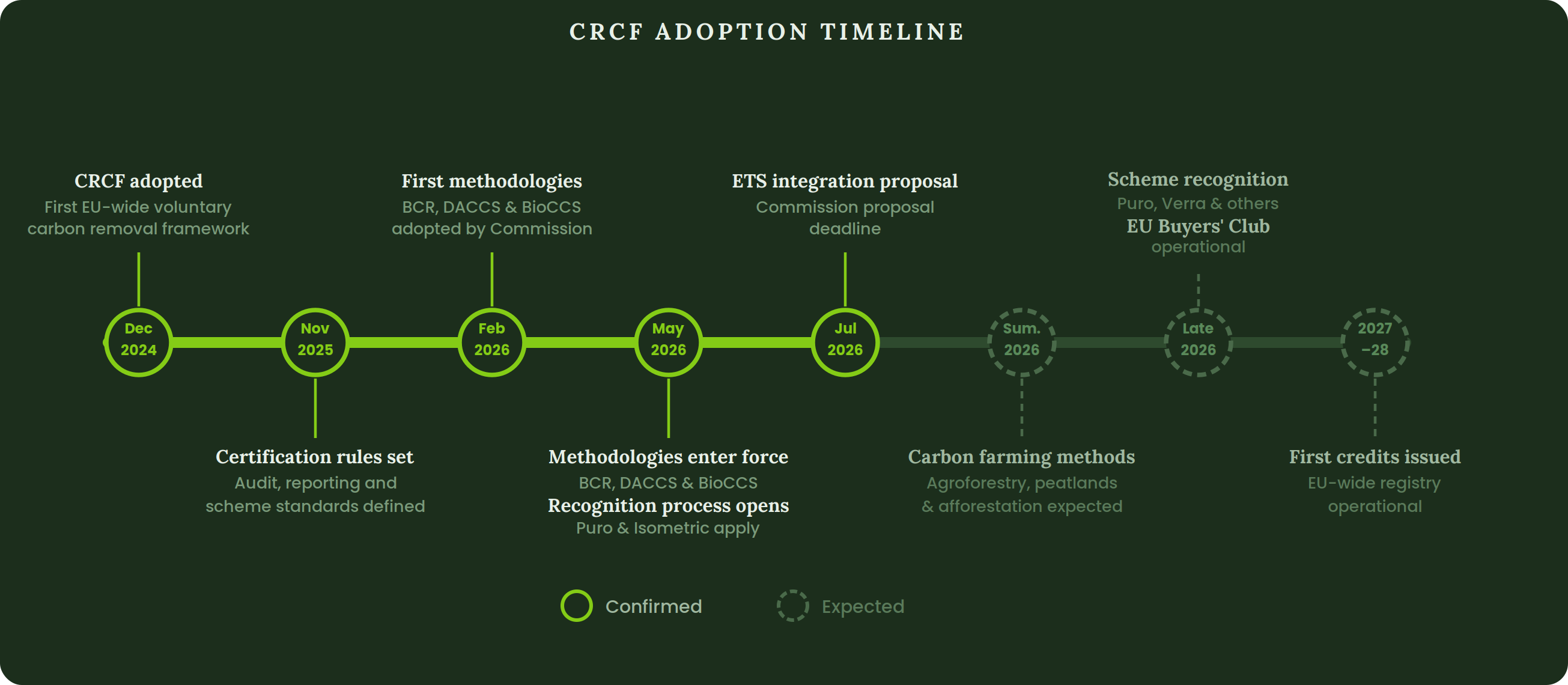
Carbon farming methodologies covering agroforestry, peatland rewetting and soil carbon sequestration are expected to be adopted by summer 2026, significantly expanding the scope of eligible activities. Scheme recognition decisions for Puro, Isometric and other standards are expected towards the end of 2026. Given that verification body accreditation can only begin after scheme recognition, the first CRCF credits will likely only be issued in 2027 or 2028. By that point, an EU-wide registry tracking all certified units is expected to be operational.
By July 2026, the European Commission will present a proposal outlining how certified CRCF removal credits could be integrated into the EU Emissions Trading System. Although integration remains some years away at the earliest, if it does proceed it would provide a significant and consistent demand stream for project developers beyond the existing voluntary market. The EU Buyers' Club is a further initiative designed to stimulate demand. This demand coordination platform, established by the European Commission in collaboration with private sector players and expected to be operational by end of 2026, aims to address demand-side barriers to project development by providing greater certainty for investment in the carbon removal market.
Conclusion
The CRCF has long-term potential to reduce market fragmentation by offering a common regulatory standard. Combined with a potential ETS integration pathway, the EU Buyers' Club and the QuALITY framework, it has the potential to boost confidence among both buyers and project developers, and provides a meaningful signal of intent from the EU about its position on carbon removals.
See if your project qualifies
Run a free eligibility assessment in under five minutes. Suggestive only - please review with a carbon expert before acting on results.
Start eligibility assessment →